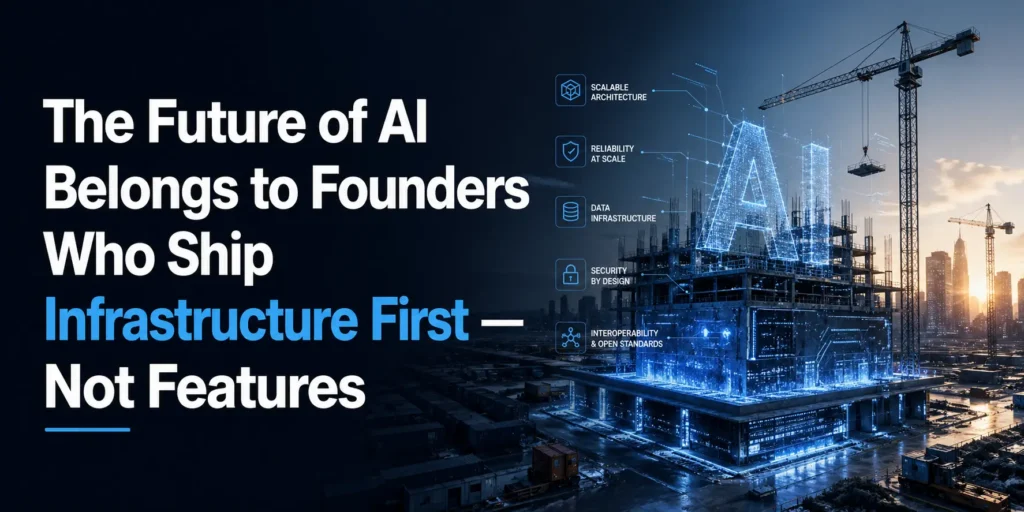
Every company that bet on ‘wait and see’ with cloud in 2008 spent the next decade buying back time it gave to AWS.
The Infrastructure Layer Is Consolidating — And the Window Is Narrow
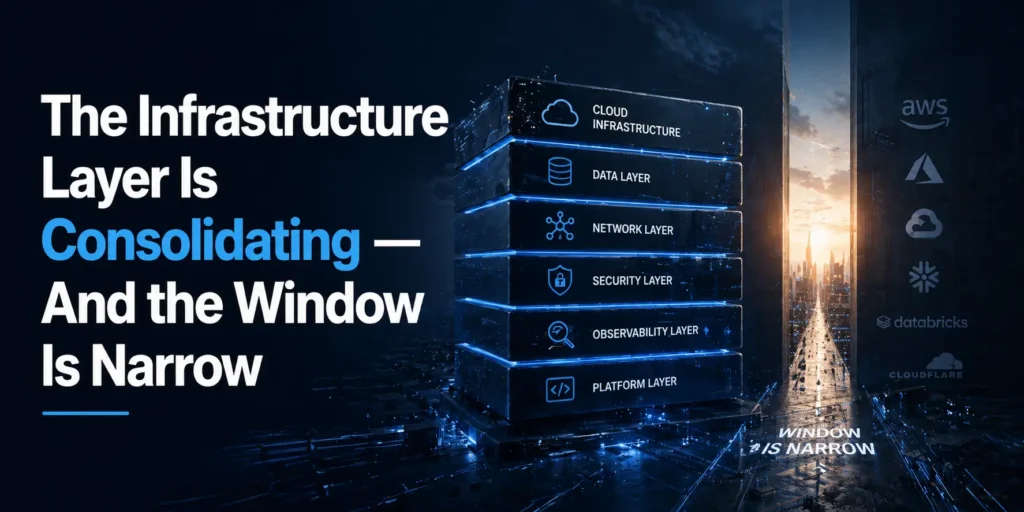
The future of AI does not belong to the team with the best model. Anthropic, OpenAI, Google, and Meta will out-research every Series A shop on earth. What those labs cannot do is own your data pipeline, your customer feedback loop, or your domain-specific evaluation harness. That is your moat — if you build it now.
Stanford’s 2024 AI Index tracked 149 large AI foundation models released in a single year. Switching costs between them remain near zero. That means any product that competes purely on ‘we use Claude’ or ‘we use GPT-4o’ carries a defensibility half-life measured in quarters, not years. The defensible layer sits one level down: proprietary retrieval infrastructure, fine-tuned domain embeddings, and evaluation pipelines that catch regressions before customers do.
Vercel shipped their AI SDK infrastructure internally six months before they opened it to the public. By the time competitors caught on, Vercel had production telemetry from thousands of real workloads. That telemetry compounded into product decisions competitors could not replicate with off-the-shelf tooling. Infrastructure built early becomes data accumulated fast — and data accumulated fast becomes the actual product.
149 Large AI foundation models released in 2024 alone (Stanford AI Index)
6 mo Head start Vercel’s internal AI SDK gave before public release
~0 Current switching cost between major frontier models for most workloads
ROI Lives in Latency Reduction, Not Capability Addition
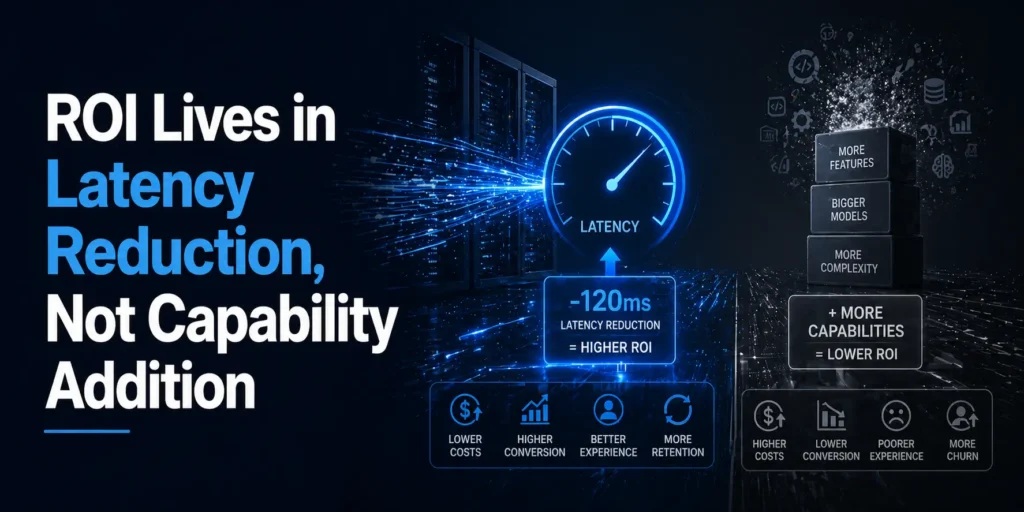
The future of AI as capability: ‘our tool now summarizes contracts’ or ‘our product generates proposals.’ Buyers fund capability pitches through curiosity budgets — small pilots that die at renewal. What survives renewals and expands into enterprise contracts is time recovered. Measurable, line-item time.
Harvey, the legal AI platform, did not lead with ‘AI reads your cases.’ They led with a 40% reduction in associate research hours — a number tied directly to partner-rate billing that partners could verify in their own timesheets within 30 days. That number closed their Series B at a $715M valuation. The capability was table stakes; the latency reduction was the product.
At Series A, your buyers sign contracts with procurement cycles averaging 90 days. You need a ROI narrative they can present upward in under three slides. ‘We cut X by Y% in Z days’ clears that bar. ‘We use advanced AI to enhance your workflow’ does not. Instrument everything from day one: task completion time, error rate per workflow, human review minutes per output. These numbers become your renewal argument and your expansion hook.
The future of AI investment thesis at Series A is not ‘this technology is impressive.’ It is ‘this technology saves our buyer $400K annually starting in month two, and our data makes it more accurate each quarter.’ Build the instrumentation that proves the second half of that sentence.
Autonomous Agents Will Break Your Current Architecture — Build for Agent Handoffs Now
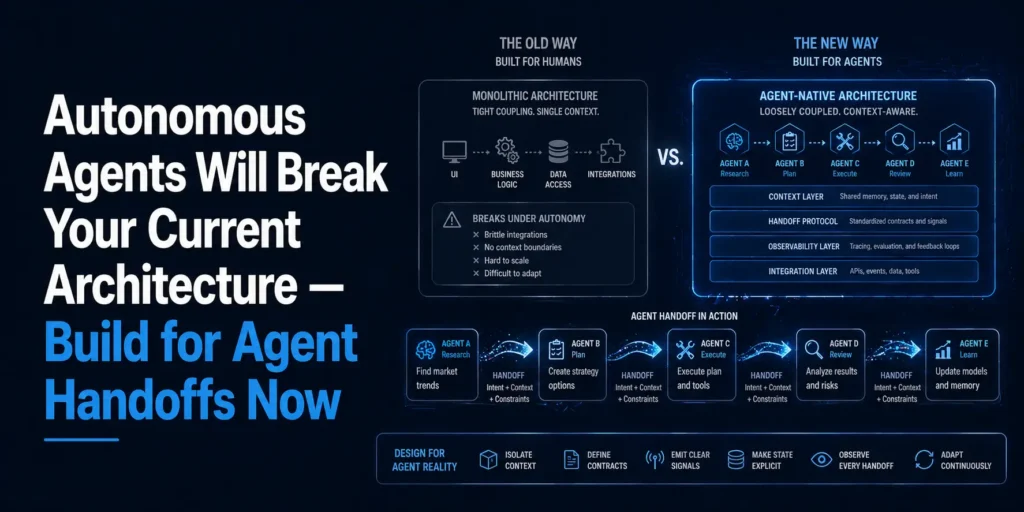
The immediate future of AI involves agents that do not just answer questions but take multi-step actions across tools, APIs, and human approval gates. Anthropic’s internal research, OpenAI’s Operator experiments, and Google’s Project Astra all point in the same direction: the next 24 months shift AI from ‘generate an answer’ to ‘complete a workflow.’ Your architecture either accommodates that shift or requires a rewrite at the worst possible time — during a growth sprint.
Perplexity built their retrieval pipeline with agent-compatible state management before they needed it. When they launched Perplexity Pages and multi-step research, they did not retrofit — they enabled. Companies that built RAG pipelines as one-shot query systems are now rebuilding them as stateful orchestrators. That rebuild costs three to six months of engineering time at a stage when you need those engineers shipping features.
Concretely: build your LLM calls behind an orchestration abstraction layer — LangGraph, CrewAI, or a lightweight internal wrapper — so you swap orchestration logic without rewriting your entire application. Store intermediate agent state in a database you control, not inside a third-party session. Design human-in-the-loop approval points as first-class API endpoints, not afterthoughts bolted onto a UI. These decisions take two weeks now and save two quarters later.
The Talent Equation Has Permanently Shifted — Hire for Judgment, Not Credentials
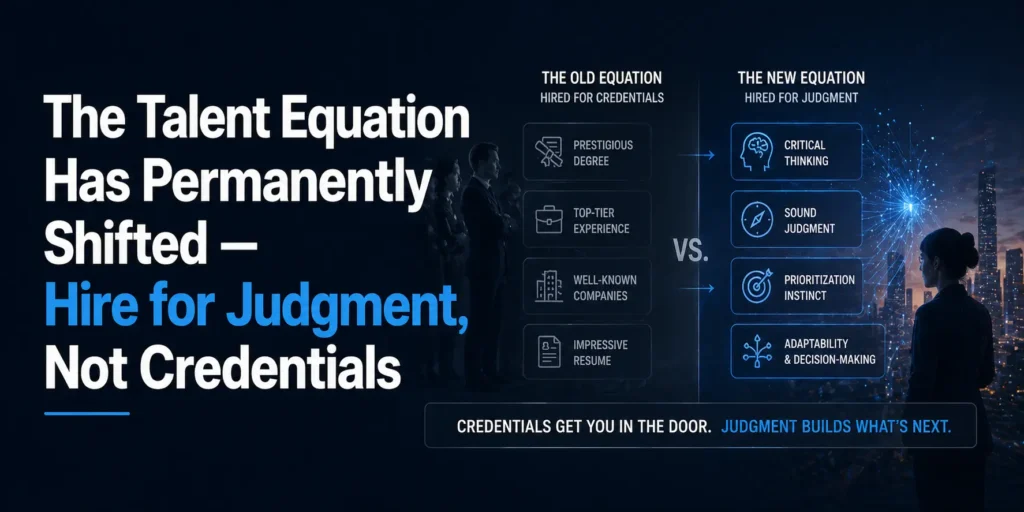
The future of AI engineering does not require PhDs. It requires engineers who exercise judgment about when to trust a model output and when to gate it behind human review. That judgment comes from production experience with failure modes, not from academic familiarity with transformer architectures.
Glean, the enterprise search company, built their early AI team by promoting two internal customer support engineers who had spent 18 months seeing exactly where AI search broke down in real customer sessions. Those engineers shipped their hallucination detection system faster than external ML hires because they recognized the failure patterns before writing a single line of code. Domain knowledge of failure beats abstract knowledge of architecture every time.
At Series A headcount, you hire four to eight engineers total. Two of them should carry explicit ownership of AI reliability: evaluation pipeline, regression testing on model updates, and user feedback triage. This is not a nice-to-have. Anthropic, OpenAI, and Google update their models on schedules you do not control. Without engineers who own reliability, a silent model update degrades your product and your customers tell you three weeks later during a renewal conversation.
Hire people who have debugged production AI failures — not people who have fine-tuned models in Jupyter notebooks. The future of AI at your scale runs on engineers who know the difference between a model problem and a prompt problem and a data problem, and who solve all three before they page the CTO.
The future of AI rewards founders who treat infrastructure as revenue strategy — not engineering overhead — and who instrument ROI before they need to defend it in a board meeting. Build the plumbing now, because the window between ‘early mover’ and ‘legacy architect
Written by Scenttemple.com