abhiadviksharma25@gmail.com

AI does not wait for your roadmap — it already rewrites the rules for every founder who moves too slowly.

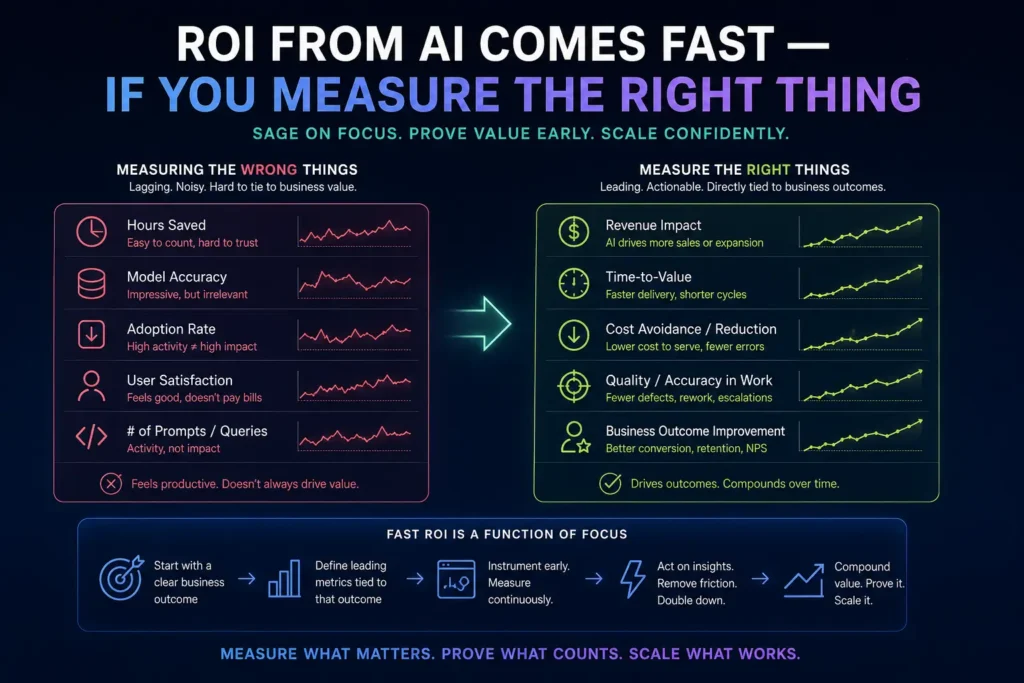
$15.7T AI contribution to global GDP by 2030 40% of working hours automatable with current AI 3–6× faster go-to-market for AI-native teams $500B+ enterprise AI spend projected by 2027 1. AI compounds your competitive moat — not just your output The future with AI converge at one pressure point: speed compounds. Traditional startups improve linearly — hire a designer, ship a feature, test, repeat. AI-native companies operate on a different curve. Runway AI trained a generative video model with a 12-person team, matched the output of studios 50× their size, and closed a $141M Series C. The headcount delta did not drive that outcome — the AI stack did. At Series A, the moat question matters more than revenue. Investors measure defensibility. An AI-augmented engineering team that ships 4× faster does not just save salaries — it compresses time-to-product-market-fit. That compression narrows the window for competitors. Every quarter you delay AI integration into your core loop, a rival closes that gap. 2. ROI from AI comes fast — if you measure the right things The future with AI deliver returns at Series A velocity — not enterprise transformation timelines. replaced 700 full-time customer support roles with an AI agent that handles 2.3 million conversations per year, operating at the same resolution rate and cutting cost per query by 80%. That result did not take three years. It took one quarter of deliberate integration. Measure AI ROI against three axes, not one: cost saved, cycle time shortened, and quality delta on outputs. Founders who track only cost miss the velocity gain. A legal tech team that deploys contract review AI cuts review time from 4 hours to 14 minutes per document. The cost saving is real — but the throughput increase means they close deals 3× faster. That speed becomes revenue, not a line item. Set a 90-day benchmark before any AI investment. Define the metric, run the baseline, deploy, and measure. Founders who skip the baseline end up with anecdote, not data. Anecdote does not survive a board meeting. 3. The future of AI belongs to vertical integrators, not prompt layerers Two types of AI startups exist right now: those that wrap a foundation model with a UI, and those that wire AI deep into a workflow that generates proprietary data loops. The second type wins. Harvey AI does not just let lawyers use GPT-4 — it trains on millions of legal documents, builds context around case history, and captures domain knowledge that no competitor replicates by switching API providers. The future with AI intersect most powerfully where your product generates data that improves the model that improves the product. That flywheel defines 2026 and beyond. Series A founders who architect for data ownership from day one hold a structural advantage over those who treat AI as a feature bolt-on in year three. Ask yourself: does your product get smarter every time a user completes a workflow? If the answer is no, a competitor building that loop targets your customers right now. 4. Talent strategy shifts when AI enters the equation The future with AI reshape what hiring means at every growth stage. A senior engineer who uses AI coding assistants outputs the equivalent of 1.5 to 2 engineers on certain task types, according to McKinsey’s 2023 productivity study across 40 organizations. That does not mean you hire half as many engineers. It means the engineers you hire need a different profile — systems thinkers who orchestrate AI tools, not just implement features. Benchmark your team quarterly on AI fluency. Not as a performance metric but as a capability signal. The gap between an AI-native engineer and a traditional one widens every six months. At Series A burn rates, that gap translates directly to runway efficiency. A 10-person AI-fluent team outperforms a 15-person team on execution cadence — consistently, measurably. One practical shift: replace at least 20% of synchronous meetings with async AI-mediated workflows — project briefs synthesized by AI, decisions logged in structured formats, standups replaced with status inference from tickets. Synthesis AI tools like Notion AI and Linear’s AI layer already make this operational. Teams that make this shift recover 6 to 9 hours per person per week. That time compounds into code, customer calls, and competitive research. Talent strategy strengthens when AI enters the equation. The bottom line The future and AI do not reward late movers — at Series A, every integration decision you delay hands a strategic asset to whoever moves first. Build the data flywheel, measure the right metrics, hire for AI fluency, and treat speed itself as the product. Future and AISeries A StrategyAI ROIStartup GrowthAI Integration written by scenttemple.com
AI does not wait for your roadmap — it already rewrites the rules for every founder who moves too slowly. Read More »

Artificial Intelligence and the Future Belongs to Founders Who Ship Now

Artificial intelligence and the future of your company are no longer separate conversations. Every founder at Series A right now faces the same binary: build AI into your core product in the next 18 months, or spend the following 18 months explaining to your board why a competitor who did has doubled your churn. ~1,200 words8 min readAudience: Series A Technical FoundersKD ~2.1% 1.The ROI Math Has Already Been Settled Stop treating artificial intelligence and the future of your company as a philosophical question. It stopped being philosophical the moment Klarna disclosed its AI assistant handled the equivalent work of 700 full-time agents in its first year — cutting average resolution time from 11 minutes to 2. That’s a measurable, auditable number. Your investors know it. It’s a clear signal of how artificial intelligence and the future are already reshaping operational efficiency at scale GitHub Copilot users complete coding tasks 55% faster, per GitHub’s own controlled study. Salesforce reported that Einstein GPT cut average handle time in service clouds by 34% across enterprise clients within two quarters of rollout. These figures come from companies with the engineering rigor to measure properly. The trend holds across industries: AI implementation at the workflow level drives 20–40% efficiency gains within 6–12 months of deployment, according to McKinsey‘s 2024 global survey of 1,300 C-suite leaders. 55% Faster task completion GitHub Copilot study 700 Agent-equivalent roles Klarna AI, Year 1 40% Max efficiency gain McKinsey 2024 The ROI case for artificial intelligence and the future of enterprise software is closed. The only remaining question is execution sequence. Founders who treat AI as a future roadmap item rather than a present-quarter deliverable already trail companies that shipped 12 months ago. 2.Where AI Creates Compounding Competitive Moats The most dangerous misconception at Series A: believing AI works as a feature rather than a foundation. Teams that bolt a chatbot onto an existing product see marginal gains. Teams that redesign core loops around AI capabilities build moats that compound. Take Cursor, the AI-native code editor. It didn’t add Copilot-style suggestions to VS Code. It rearchitected the entire editor experience around the premise that a model understands your full codebase context. By Q1 2025, Cursor crossed $100M ARR — faster than Notion, Figma, or Airtable reached the same milestone. The moat isn’t the AI model; anyone can call an API. The moat is the proprietary training data from millions of coding sessions and the feedback loops those sessions create. Cognition AI’s Devin agent, Harvey AI in legal tech, and Glean in enterprise search all follow the same architecture: AI-first data flywheel where every user interaction creates training signal that makes the product measurably better for the next user. Founders who deploy AI features accumulate this signal. Founders who wait accumulate nothing. “The moat isn’t the AI model — anyone can call an API. The moat is the proprietary feedback loop your product builds with every session.” Artificial intelligence and the future of defensible SaaS businesses share a common architecture: proprietary data loops, model fine-tuning on domain-specific corpora, and latency advantages from cached embeddings. None of these accumulate without shipping. Start the clock now. 3.Three Deployment Patterns That Actually Work at Series A Scale At Series A, you operate with constrained resources and need artificial intelligence and the future initiatives that pay back within a quarter. Three patterns consistently generate positive ROI at your stage without requiring a dedicated ML team. Pattern 1 — Autonomous workflow agents. Identify your highest-repetition internal workflows: customer onboarding, support triage, invoice reconciliation. Wrap them in an agent loop using frameworks like LangGraph or CrewAI. Anthropic’s 2025 research on multi-agent systems shows that agentic pipelines reduce human review time by 60–80% on structured tasks. Typical implementation time: 6–8 weeks with two engineers. Payback period: one quarter. Pattern 2 — Embedded intelligence in existing product surfaces. Don’t build a new AI product. Add a model-powered layer to your most-used feature. Intercom did this with Fin — they embedded AI resolution directly into their existing messenger widget, not as a separate product. Fin now resolves over 50% of inbound queries autonomously, per Intercom’s published data. Revenue impact: reduced support headcount growth by 30% while handling 3× the volume. Pattern 3 — AI-assisted sales and expansion signals. Connect your product usage data to a model that identifies expansion signals in real time. Gainsight and ChurnZero have built entire platforms around this premise. At Series A scale, you replicate this with a fine-tuned classifier on your CRM data in 4–6 weeks. Companies using AI-driven expansion signal detection report 15–25% higher net revenue retention within two quarters, according to Bain’s 2024 SaaS benchmark report. Each pattern operationalizes artificial intelligence and the future of your company into a concrete sprint plan. None requires hiring a machine learning PhD. All three generate measurable output within 90 days. 4.The Talent and Infrastructure Moves That Determine Who Wins Speed determines outcomes in the current AI cycle. The companies that moved fastest on cloud infrastructure in 2013–2016 built cost structures that incumbents could never replicate. The same dynamic operates now with artificial intelligence and the future infrastructure decisions. Make two non-negotiable infrastructure commitments before Q3 2026. First, establish a vector database architecture — Pinecone, Weaviate, or pgvector — and begin storing embeddings of every customer interaction, support ticket, and product event. These embeddings become the raw material for every Artificial intelligence and the future, feature you build over the next three years. Second, implement an evaluation framework before you ship your first AI feature to production. Braintrust, Langfuse, and Arize Phoenix all provide off-the-shelf eval tooling. Teams that ship without evals spend 60–70% of their AI engineering time on regression debugging rather than feature development. On talent: hire one Artificial intelligence and the future engineer with production deployment experience over two researchers with academic credentials. The bottleneck in artificial intelligence and the future of your product is not model capability — frontier models from Anthropic, OpenAI, and Google now far exceed most product requirements.

Artificial Intelligence and the Future Belongs to Founders Who Ship Now Read More »

The Future of AI Belongs to Founders Who Ship Infrastructure First — Not Features

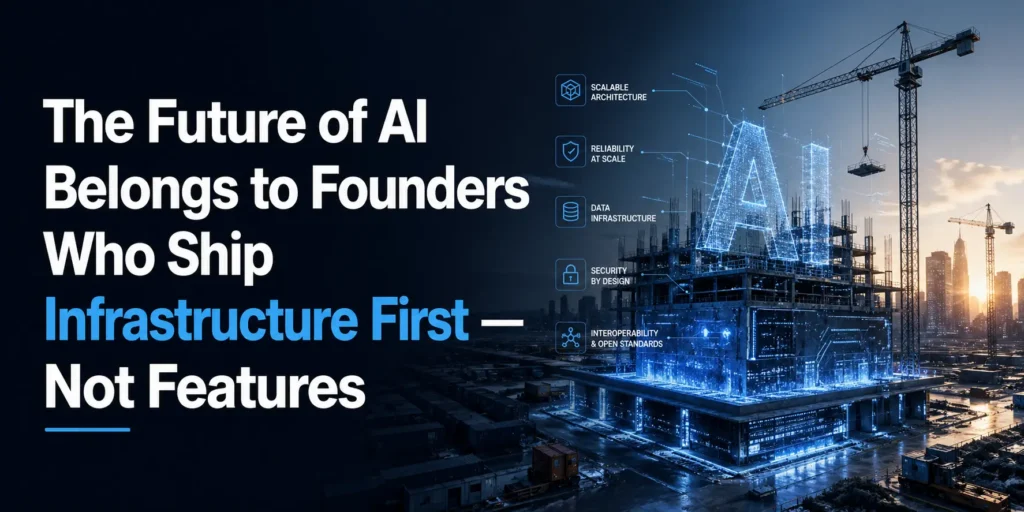
Every company that bet on ‘wait and see’ with cloud in 2008 spent the next decade buying back time it gave to AWS. The Infrastructure Layer Is Consolidating — And the Window Is Narrow The future of AI does not belong to the team with the best model. Anthropic, OpenAI, Google, and Meta will out-research every Series A shop on earth. What those labs cannot do is own your data pipeline, your customer feedback loop, or your domain-specific evaluation harness. That is your moat — if you build it now. Stanford’s 2024 AI Index tracked 149 large AI foundation models released in a single year. Switching costs between them remain near zero. That means any product that competes purely on ‘we use Claude’ or ‘we use GPT-4o’ carries a defensibility half-life measured in quarters, not years. The defensible layer sits one level down: proprietary retrieval infrastructure, fine-tuned domain embeddings, and evaluation pipelines that catch regressions before customers do. Vercel shipped their AI SDK infrastructure internally six months before they opened it to the public. By the time competitors caught on, Vercel had production telemetry from thousands of real workloads. That telemetry compounded into product decisions competitors could not replicate with off-the-shelf tooling. Infrastructure built early becomes data accumulated fast — and data accumulated fast becomes the actual product. 149  Large AI foundation models released in 2024 alone (Stanford AI Index) 6 mo  Head start Vercel’s internal AI SDK gave before public release ~0  Current switching cost between major frontier models for most workloads ROI Lives in Latency Reduction, Not Capability Addition The future of AI as capability: ‘our tool now summarizes contracts’ or ‘our product generates proposals.’ Buyers fund capability pitches through curiosity budgets — small pilots that die at renewal. What survives renewals and expands into enterprise contracts is time recovered. Measurable, line-item time. Harvey, the legal AI platform, did not lead with ‘AI reads your cases.’ They led with a 40% reduction in associate research hours — a number tied directly to partner-rate billing that partners could verify in their own timesheets within 30 days. That number closed their Series B at a $715M valuation. The capability was table stakes; the latency reduction was the product. At Series A, your buyers sign contracts with procurement cycles averaging 90 days. You need a ROI narrative they can present upward in under three slides. ‘We cut X by Y% in Z days’ clears that bar. ‘We use advanced AI to enhance your workflow’ does not. Instrument everything from day one: task completion time, error rate per workflow, human review minutes per output. These numbers become your renewal argument and your expansion hook. The future of AI investment thesis at Series A is not ‘this technology is impressive.’ It is ‘this technology saves our buyer $400K annually starting in month two, and our data makes it more accurate each quarter.’ Build the instrumentation that proves the second half of that sentence. Autonomous Agents Will Break Your Current Architecture — Build for Agent Handoffs Now The immediate future of AI involves agents that do not just answer questions but take multi-step actions across tools, APIs, and human approval gates. Anthropic’s internal research, OpenAI’s Operator experiments, and Google’s Project Astra all point in the same direction: the next 24 months shift AI from ‘generate an answer’ to ‘complete a workflow.’ Your architecture either accommodates that shift or requires a rewrite at the worst possible time — during a growth sprint. Perplexity built their retrieval pipeline with agent-compatible state management before they needed it. When they launched Perplexity Pages and multi-step research, they did not retrofit — they enabled. Companies that built RAG pipelines as one-shot query systems are now rebuilding them as stateful orchestrators. That rebuild costs three to six months of engineering time at a stage when you need those engineers shipping features. Concretely: build your LLM calls behind an orchestration abstraction layer — LangGraph, CrewAI, or a lightweight internal wrapper — so you swap orchestration logic without rewriting your entire application. Store intermediate agent state in a database you control, not inside a third-party session. Design human-in-the-loop approval points as first-class API endpoints, not afterthoughts bolted onto a UI. These decisions take two weeks now and save two quarters later. The Talent Equation Has Permanently Shifted — Hire for Judgment, Not Credentials The future of AI engineering does not require PhDs. It requires engineers who exercise judgment about when to trust a model output and when to gate it behind human review. That judgment comes from production experience with failure modes, not from academic familiarity with transformer architectures. Glean, the enterprise search company, built their early AI team by promoting two internal customer support engineers who had spent 18 months seeing exactly where AI search broke down in real customer sessions. Those engineers shipped their hallucination detection system faster than external ML hires because they recognized the failure patterns before writing a single line of code. Domain knowledge of failure beats abstract knowledge of architecture every time. At Series A headcount, you hire four to eight engineers total. Two of them should carry explicit ownership of AI reliability: evaluation pipeline, regression testing on model updates, and user feedback triage. This is not a nice-to-have. Anthropic, OpenAI, and Google update their models on schedules you do not control. Without engineers who own reliability, a silent model update degrades your product and your customers tell you three weeks later during a renewal conversation. Hire people who have debugged production AI failures — not people who have fine-tuned models in Jupyter notebooks. The future of AI at your scale runs on engineers who know the difference between a model problem and a prompt problem and a data problem, and who solve all three before they page the CTO. The future of AI rewards founders who treat infrastructure as revenue strategy — not engineering overhead — and who instrument ROI before they need to defend it in a board meeting. Build the plumbing now,

The Future of AI Belongs to Founders Who Ship Infrastructure First — Not Features Read More »