$15.7T
AI contribution to global GDP by 2030
40%
of working hours automatable with current AI
3–6×
faster go-to-market for AI-native teams
$500B+
enterprise AI spend projected by 2027
1. AI compounds your competitive moat — not just your output
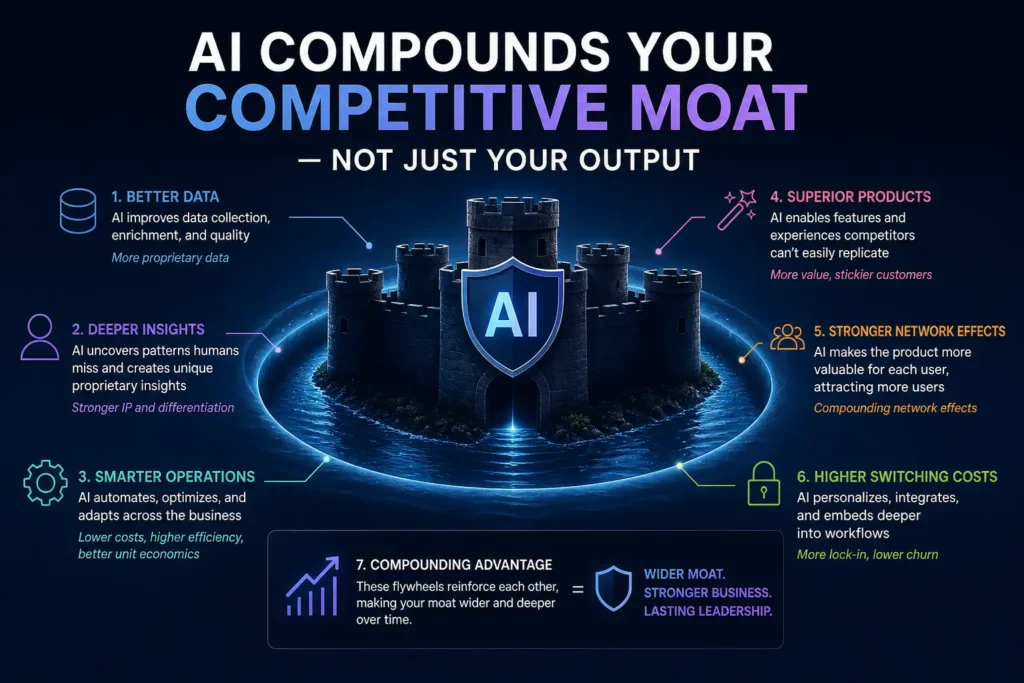
The future with AI converge at one pressure point: speed compounds. Traditional startups improve linearly — hire a designer, ship a feature, test, repeat. AI-native companies operate on a different curve. Runway AI trained a generative video model with a 12-person team, matched the output of studios 50× their size, and closed a $141M Series C. The headcount delta did not drive that outcome — the AI stack did.
At Series A, the moat question matters more than revenue. Investors measure defensibility. An AI-augmented engineering team that ships 4× faster does not just save salaries — it compresses time-to-product-market-fit. That compression narrows the window for competitors. Every quarter you delay AI integration into your core loop, a rival closes that gap.
2. ROI from AI comes fast — if you measure the right things
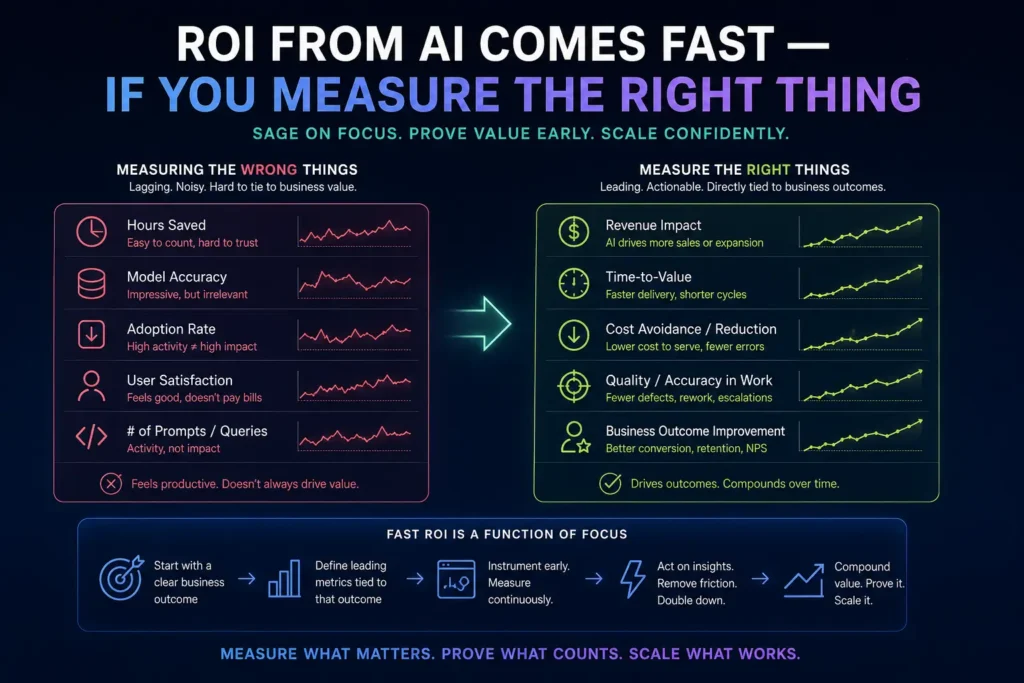
The future with AI deliver returns at Series A velocity — not enterprise transformation timelines. replaced 700 full-time customer support roles with an AI agent that handles 2.3 million conversations per year, operating at the same resolution rate and cutting cost per query by 80%. That result did not take three years. It took one quarter of deliberate integration.
Measure AI ROI against three axes, not one: cost saved, cycle time shortened, and quality delta on outputs. Founders who track only cost miss the velocity gain. A legal tech team that deploys contract review AI cuts review time from 4 hours to 14 minutes per document. The cost saving is real — but the throughput increase means they close deals 3× faster. That speed becomes revenue, not a line item.
Set a 90-day benchmark before any AI investment. Define the metric, run the baseline, deploy, and measure. Founders who skip the baseline end up with anecdote, not data. Anecdote does not survive a board meeting.
3. The future of AI belongs to vertical integrators, not prompt layerers
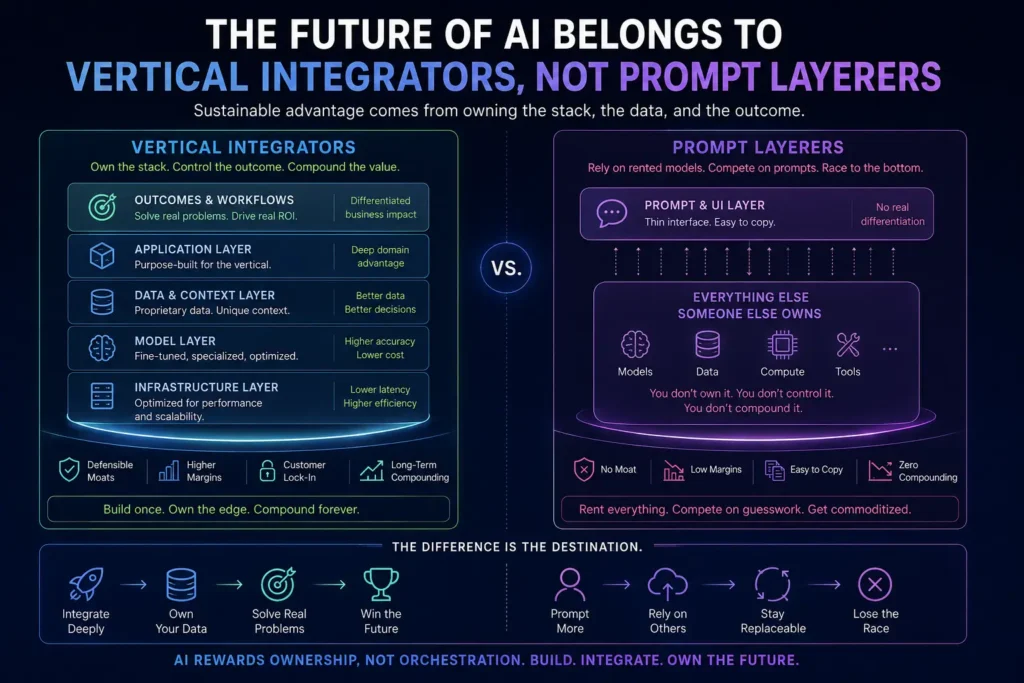
Two types of AI startups exist right now: those that wrap a foundation model with a UI, and those that wire AI deep into a workflow that generates proprietary data loops. The second type wins. Harvey AI does not just let lawyers use GPT-4 — it trains on millions of legal documents, builds context around case history, and captures domain knowledge that no competitor replicates by switching API providers.
The future with AI intersect most powerfully where your product generates data that improves the model that improves the product. That flywheel defines 2026 and beyond. Series A founders who architect for data ownership from day one hold a structural advantage over those who treat AI as a feature bolt-on in year three.
Ask yourself: does your product get smarter every time a user completes a workflow? If the answer is no, a competitor building that loop targets your customers right now.
4. Talent strategy shifts when AI enters the equation
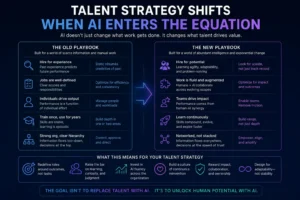
The future with AI reshape what hiring means at every growth stage. A senior engineer who uses AI coding assistants outputs the equivalent of 1.5 to 2 engineers on certain task types, according to McKinsey’s 2023 productivity study across 40 organizations. That does not mean you hire half as many engineers. It means the engineers you hire need a different profile — systems thinkers who orchestrate AI tools, not just implement features.
Benchmark your team quarterly on AI fluency. Not as a performance metric but as a capability signal. The gap between an AI-native engineer and a traditional one widens every six months. At Series A burn rates, that gap translates directly to runway efficiency. A 10-person AI-fluent team outperforms a 15-person team on execution cadence — consistently, measurably.
One practical shift: replace at least 20% of synchronous meetings with async AI-mediated workflows — project briefs synthesized by AI, decisions logged in structured formats, standups replaced with status inference from tickets. Synthesis AI tools like Notion AI and Linear’s AI layer already make this operational. Teams that make this shift recover 6 to 9 hours per person per week. That time compounds into code, customer calls, and competitive research. Talent strategy strengthens when AI enters the equation.
The bottom line
The future and AI do not reward late movers — at Series A, every integration decision you delay hands a strategic asset to whoever moves first. Build the data flywheel, measure the right metrics, hire for AI fluency, and treat speed itself as the product.
Future and AISeries A StrategyAI ROIStartup GrowthAI Integration
written by scenttemple.com