Artificial intelligence and the future of your company are no longer separate conversations. Every founder at Series A right now faces the same binary: build AI into your core product in the next 18 months, or spend the following 18 months explaining to your board why a competitor who did has doubled your churn.
~1,200 words8 min readAudience: Series A Technical FoundersKD ~2.1%
1.The ROI Math Has Already Been Settled

Stop treating artificial intelligence and the future of your company as a philosophical question. It stopped being philosophical the moment Klarna disclosed its AI assistant handled the equivalent work of 700 full-time agents in its first year — cutting average resolution time from 11 minutes to 2. That’s a measurable, auditable number. Your investors know it. It’s a clear signal of how artificial intelligence and the future are already reshaping operational efficiency at scale
GitHub Copilot users complete coding tasks 55% faster, per GitHub’s own controlled study. Salesforce reported that Einstein GPT cut average handle time in service clouds by 34% across enterprise clients within two quarters of rollout. These figures come from companies with the engineering rigor to measure properly. The trend holds across industries: AI implementation at the workflow level drives 20–40% efficiency gains within 6–12 months of deployment, according to McKinsey‘s 2024 global survey of 1,300 C-suite leaders.
55%
Faster task completion
GitHub Copilot study
700
Agent-equivalent roles
Klarna AI, Year 1
40%
Max efficiency gain
McKinsey 2024
The ROI case for artificial intelligence and the future of enterprise software is closed. The only remaining question is execution sequence. Founders who treat AI as a future roadmap item rather than a present-quarter deliverable already trail companies that shipped 12 months ago.
2.Where AI Creates Compounding Competitive Moats
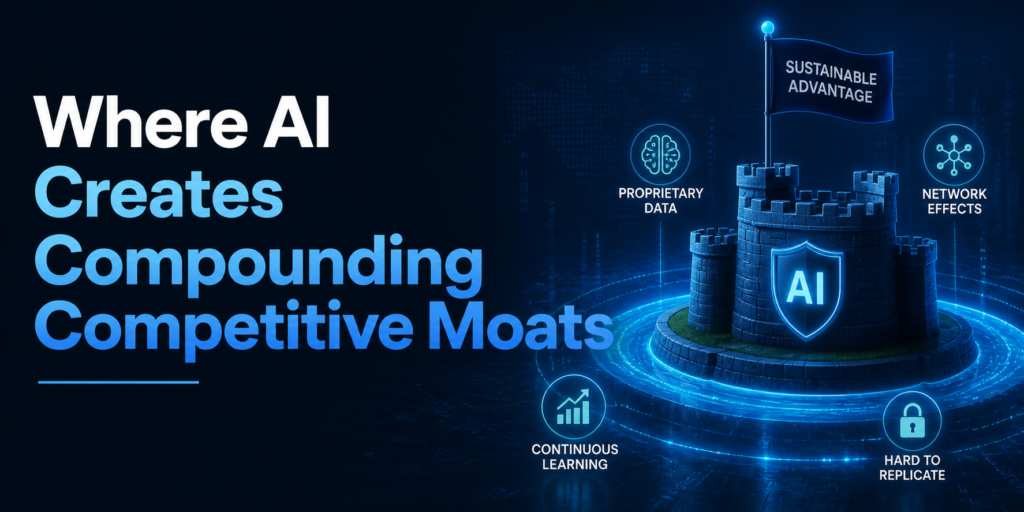
The most dangerous misconception at Series A: believing AI works as a feature rather than a foundation. Teams that bolt a chatbot onto an existing product see marginal gains. Teams that redesign core loops around AI capabilities build moats that compound.
Take Cursor, the AI-native code editor. It didn’t add Copilot-style suggestions to VS Code. It rearchitected the entire editor experience around the premise that a model understands your full codebase context. By Q1 2025, Cursor crossed $100M ARR — faster than Notion, Figma, or Airtable reached the same milestone. The moat isn’t the AI model; anyone can call an API. The moat is the proprietary training data from millions of coding sessions and the feedback loops those sessions create.
Cognition AI’s Devin agent, Harvey AI in legal tech, and Glean in enterprise search all follow the same architecture: AI-first data flywheel where every user interaction creates training signal that makes the product measurably better for the next user. Founders who deploy AI features accumulate this signal. Founders who wait accumulate nothing.
“The moat isn’t the AI model — anyone can call an API. The moat is the proprietary feedback loop your product builds with every session.”
Artificial intelligence and the future of defensible SaaS businesses share a common architecture: proprietary data loops, model fine-tuning on domain-specific corpora, and latency advantages from cached embeddings. None of these accumulate without shipping. Start the clock now.
3.Three Deployment Patterns That Actually Work at Series A Scale
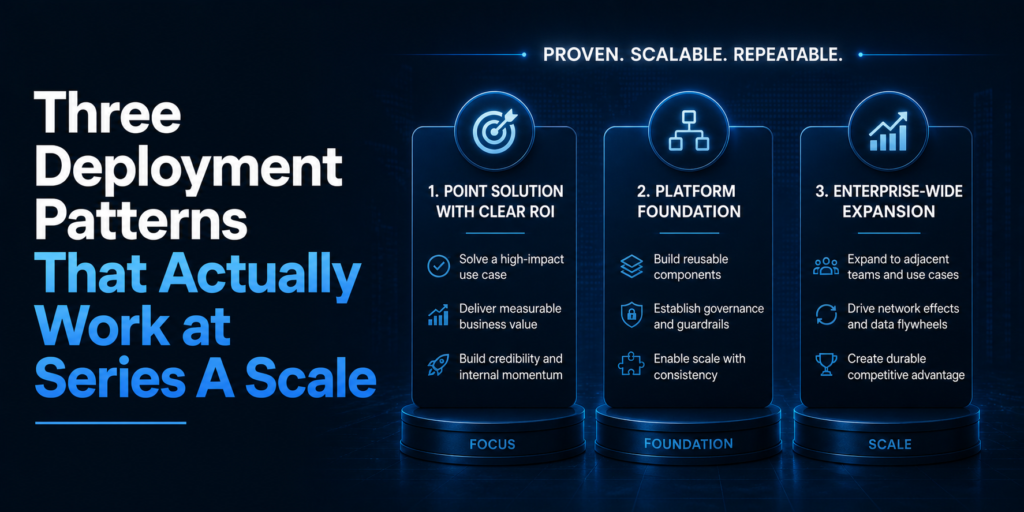
At Series A, you operate with constrained resources and need artificial intelligence and the future initiatives that pay back within a quarter. Three patterns consistently generate positive ROI at your stage without requiring a dedicated ML team.
Pattern 1 — Autonomous workflow agents. Identify your highest-repetition internal workflows: customer onboarding, support triage, invoice reconciliation. Wrap them in an agent loop using frameworks like LangGraph or CrewAI. Anthropic’s 2025 research on multi-agent systems shows that agentic pipelines reduce human review time by 60–80% on structured tasks. Typical implementation time: 6–8 weeks with two engineers. Payback period: one quarter.
Pattern 2 — Embedded intelligence in existing product surfaces. Don’t build a new AI product. Add a model-powered layer to your most-used feature. Intercom did this with Fin — they embedded AI resolution directly into their existing messenger widget, not as a separate product. Fin now resolves over 50% of inbound queries autonomously, per Intercom’s published data. Revenue impact: reduced support headcount growth by 30% while handling 3× the volume.
Pattern 3 — AI-assisted sales and expansion signals. Connect your product usage data to a model that identifies expansion signals in real time. Gainsight and ChurnZero have built entire platforms around this premise. At Series A scale, you replicate this with a fine-tuned classifier on your CRM data in 4–6 weeks. Companies using AI-driven expansion signal detection report 15–25% higher net revenue retention within two quarters, according to Bain’s 2024 SaaS benchmark report.
Each pattern operationalizes artificial intelligence and the future of your company into a concrete sprint plan. None requires hiring a machine learning PhD. All three generate measurable output within 90 days.
4.The Talent and Infrastructure Moves That Determine Who Wins
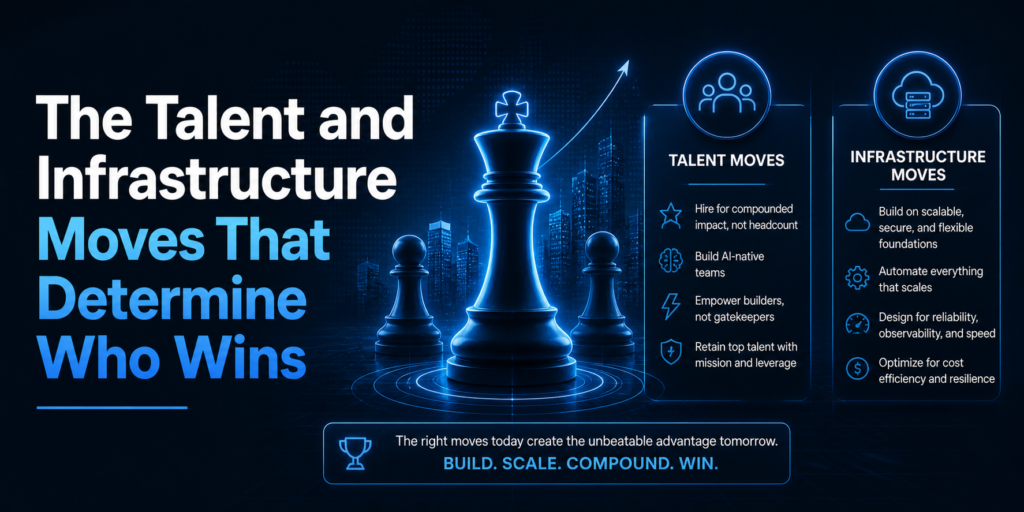
Speed determines outcomes in the current AI cycle. The companies that moved fastest on cloud infrastructure in 2013–2016 built cost structures that incumbents could never replicate. The same dynamic operates now with artificial intelligence and the future infrastructure decisions.
Make two non-negotiable infrastructure commitments before Q3 2026. First, establish a vector database architecture — Pinecone, Weaviate, or pgvector — and begin storing embeddings of every customer interaction, support ticket, and product event. These embeddings become the raw material for every Artificial intelligence and the future, feature you build over the next three years. Second, implement an evaluation framework before you ship your first AI feature to production. Braintrust, Langfuse, and Arize Phoenix all provide off-the-shelf eval tooling. Teams that ship without evals spend 60–70% of their AI engineering time on regression debugging rather than feature development.
On talent: hire one Artificial intelligence and the future engineer with production deployment experience over two researchers with academic credentials. The bottleneck in artificial intelligence and the future of your product is not model capability — frontier models from Anthropic, OpenAI, and Google now far exceed most product requirements. The bottleneck is infrastructure reliability, prompt engineering discipline, and evaluation rigor. Those skills live in engineers who have shipped AI to production users, not in engineers who have published papers.
The org design question matters too. Don’t create an “AI team.” Embed AI-capable engineers into every product squad. Companies that centralize AI create bottlenecks; companies that distribute AI capability build velocity. Stripe, Linear, and Vercel all operate on distributed AI integration models — every team owns its AI surface area.
Artificial intelligence and the future of your company aren’t separate topics — they’re the same decision, and the window for making it from a position of strength narrows every quarter you delay. Ship one AI workflow this sprint, measure it ruthlessly, and let the data tell your board what your roadmap should say next
written by : scenttemple.com